Zhina: Daughter of Kurdistan, the Voice of “Woman, Life, Freedom”
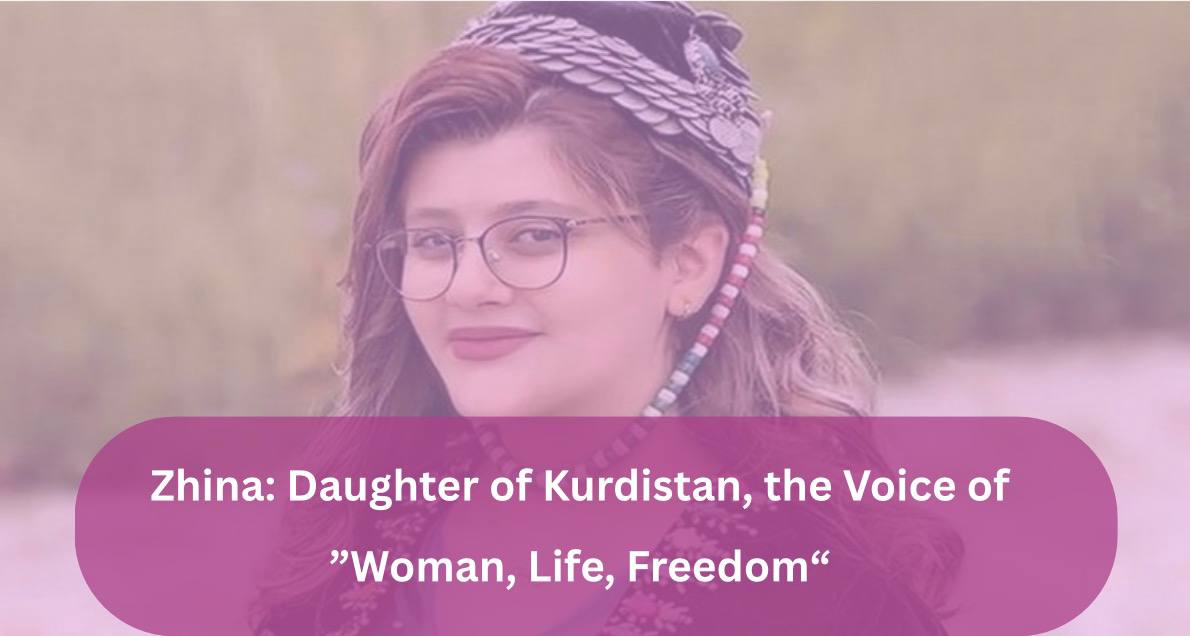
Four years have passed since that bloody September; four years since the day the name “Zhina” rose from the streets
and alleys of Kurdistan and became the name of a great uprising; four years since the day the Islamic Republic
handed a young woman from the land of Kurdistan over to its forces of repression, simply because she was a woman
and wanted to be herself, and took her life away from her. But Zhina is not merely a name.
Zhina has a mother who still waits for her daughter to come home; a father who carries the grief of losing his daughter
on his shoulders; a family that has spent four years living with her absence; and a people who, whenever they hear
her name, remember how a single life can become a cry against a regime.
And Zhina was, before she became “Mahsa” in the media, Zhina Amini—the daughter of Kurdistan.
This truth cannot and must not be forgotten.
Zhina was a Kurdish name; a name rooted in the language and culture of a people who have stood for centuries to
preserve their identity, their language, and their right to live. In Kurdish language and culture, “Zhina” carries the
meaning of life and being alive. And what a bitter tragedy it is that a government claiming to protect “life” took Zhina’s
life, yet could not silence the meaning carried within her name. She came from Kurdistan; from a land that knows pain all too well, but has never chosen silence in the face of it. For Zhina, Kurdistan was not merely a point on a map.
It was home.
It was identity.
It was language.
It was memory.
It was her mother.
It was the mountains.
And it was the culture that gave its daughter the name
“Zhina.”
That is why, when Zhina was killed, it was not merely a young woman who was killed; an old wound opened once
again. A wound that had remained upon the body of Kurdistan for years, and from that wound, a new voice was
born.
Jin, Jiyan, Azadi.
Woman, Life, Freedom.
Four years ago, the anger began in Kurdistan; in Saqqez, in the streets where the voices of the people echoed. And very soon, that voice crossed the borders of Kurdistan. From city to city, university to university, street to street, people stood together and chanted Zhina’s name. This time, Kurdistan was not alone. The pain of a Kurdish mother became the pain of millions of women. The death of a Kurdish daughter became the cry of millions of people.
Zhina’s name traveled from Saqqez to Tehran, from Tehran to Baluchistan, from Baluchistan to Gilan, from Gilan to
Khuzestan, and from Iran to the entire world. And how powerful that moment was when people, despite
all their differences, stood together behind one word:
Freedom.
But we must not forget that the spark of this uprising was lit in Kurdistan; in a land where “Jin, Jiyan, Azadi” had been
part of Kurdish women’s struggle and emancipatory thought long before it became a global slogan. That is why, whenever we say “Woman, Life, Freedom,”
we must remember Zhina.
We must remember Kurdistan.
We must remember Saqqez.
We must remember that bitter September.
Four years have passed, but for many of us, September still
carries the same scent of grief.
For four years, Zhina’s family has heard the sound of her memories instead of the sound of their daughter’s footsteps.
For four years, her photograph has passed from hand to hand among the people. For four years, her eyes, looking
out from a photograph, have watched a generation that was never the same after her death. The regime may have believed that by killing Zhina, it could bring the story to an end. But it was wrong. They killed Zhina, but Zhina remained. She lives in the hair of girls who cast aside their
headscarves.
In women who pushed fear away.
In mothers who held photographs of their children who
were killed in their arms.
In young men who stood up for women’s freedom.
In universities where Zhina’s name was shouted.
In streets stained with the blood of young people.
And in the hearts of people who still believe that life is a
human right.
Zhina is gone, but “Jin”—life— remains in her name and in her memory.
Today, on the fourth anniversary of the state killing of Zhina Amini, remembering her is not merely about
commemorating a victim. It is a reminder of a truth: no government can permanently silence a people’s desire for
freedom with bullets, batons, prisons, and executions.
Zhina was Kurdish; and her Kurdish identity must not be diminished or erased from the story of this movement.
We must speak of the daughter of Kurdistan.
Of the language that gave her her name.
Of the culture that raised her.
Of the mother who called her daughter Zhina.
Of the land from which the first cries of this movement arose. We must say that “Woman, Life, Freedom” is not merely a
slogan that was born on a single day; this cry has roots, it has a history, and an important part of those roots lies in
Kurdistan. And perhaps the most beautiful and painful truth about
Zhina is this:
A girl whom the regime wanted to turn into silence became
a voice.
A girl whose name they tried to confine became known
throughout the world.
A girl whose life they took became a symbol of life.
And a girl who came from Kurdistan carried the voice of
freedom to the ears of the world.
Four years later, her voice can still be heard in the voices of
the people:
Jin, Jiyan, Azadi.
And we can still say with all our hearts:
Zhina, you have not been forgotten.
You are alive in Kurdistan; in Saqqez, in Sanandaj, in the
mountains and the streets, in your mother tongue, in the
hearts of your family, and in the memory of a people who
have intertwined your name with freedom.
You live in every woman who no longer wants to apologize
for living her own life. You live in every human being who still carries the dream
of a free and humane Iran in their heart.
And four years after that bloody September, we still speak
your name—not only to grieve, but to remember.
So that we do not forget what happened to you.
So that we do not forget what happened to the young people
of this land.
So that we do not forget how Kurdistan raised its voice.
And so that we do not forget:
No killing can kill the truth.
No bullet can kill an ideal.
And no repression can silence the human desire for freedom
forever.
Four years have passed since you left us, Zhina;
yet your name is still the name of life.
Zhina Amini; daughter of Kurdistan, symbol of a
generation, and a name that will forever remain in the
memory of this land, forever intertwined with “Woman,
Life, Freedom.”
May your memory be honored.
May your name live forever.
And may the path to freedom continue.
Jin, Jiyan, Azadi.
Fatima Raoufi