Subordination or Humanity? The Question of Woman in the Existentialist Philosophy of Simone de Beauvoir
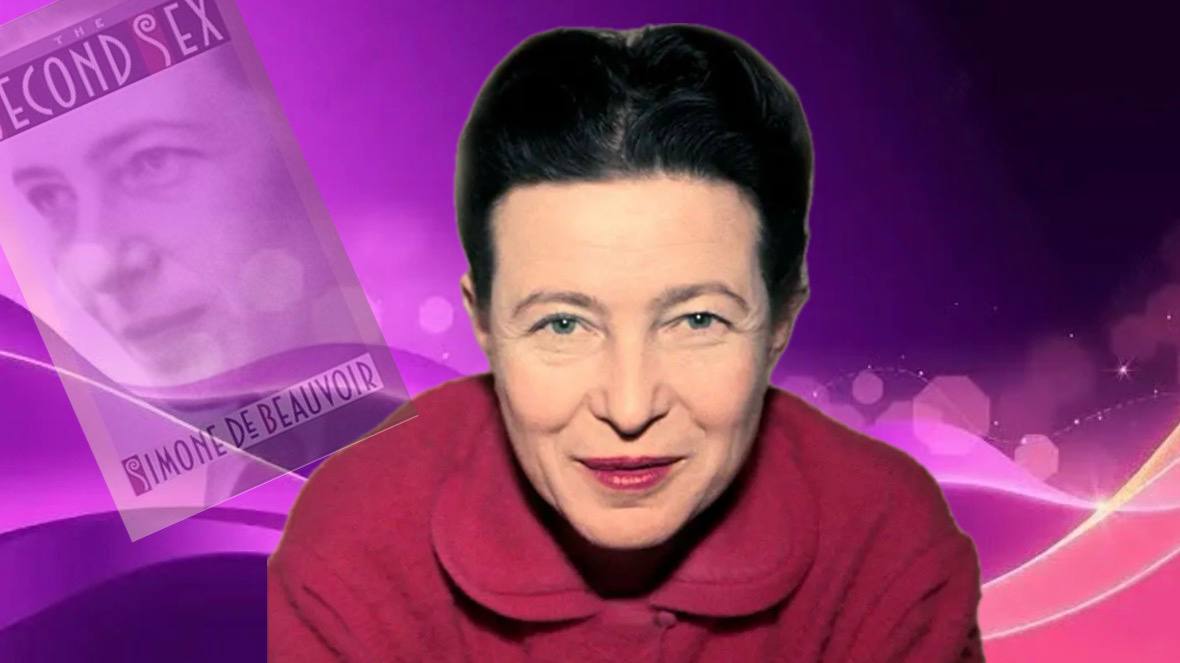
Writing a comprehensive and analytical essay on Simone de Beauvoir's philosophy and her perspective on the woman's question requires a deep dive into the intellectual, historical, psychological, and social dimensions found within her masterpiece, *The Second Sex*. In this extensive essay, we will analyze all the core components of this great philosopher's thought in continuous, successive paragraphs.
To understand the question of woman from Simone de Beauvoir's perspective, we must first understand the philosophical framework in which she lived and thought, which is existentialism. Existentialism posits that when humans are born, they possess no predefined essence or definition; rather, "existence precedes essence." This is a clear message that humans create their own identity through their choices and actions. However, when Beauvoir applies this general theory to the woman's question, she clashes with societal reality. She observes that this law only truly applies to men. In society, a man is free to define his own essence and identity, whereas when a girl is born, society has already prepared a specific essence, role, and identity for her, preventing her from developing freely. From this starting point, Beauvoir begins to dismantle the conventional concepts that view femininity as a natural or divine trait, proving that what is called "woman" is the result of a long educational and cultural process designed by a patriarchal system.
Beauvoir's famous statement, "One is not born, but rather becomes a woman," forms the core and nucleus of entire modern feminism. This sentence is not merely a political slogan, but a major shift in gender theory, distinguishing clearly between biological sex and social gender. Anatomically and biologically, the female possesses a set of physical characteristics necessary for reproduction. However, Beauvoir emphasizes that these physiological differences carry no philosophical or moral value and should not determine a person's human status. What later manifests as "femininity" or female traits—such as shyness, weakness, emotionality, or a passion for domesticity—is not inherent in a girl's genetics. Instead, from the moment she opens her eyes to the world, it is fed to her through toys, ways of speaking, clothing, and societal expectations. Society forces the girl to shape herself into an attractive and submissive object for man, and thus, social classification turns the biological female into the cultural being called a woman.
Another vital theme in Beauvoir's philosophy is the concept of "The Other" or alteration, in which she explains how history has always identified man as the primary pole and the measure of humanity. In daily language, and even in philosophical and religious texts, the word "man" has often been used as a synonym for "human." This has granted man an absolute and independent identity, making him the philosophical "Subject." In contrast, woman is defined and valued only in relation to man; she is granted meaning only as a man's daughter, wife, or mother. Beauvoir notes that this relationship between man and woman is unlike any other relationship of oppression in history. For instance, in racial or class oppression, the oppressed can unite and revolt because they are linked geographically or socially. A woman, however, cannot rebel in the same way because she is organically and emotionally tied to her oppressor—man. They live together in the same house, bound by economic and familial interests, making the liberation of woman the most complex historical process.
In *The Second Sex*, Beauvoir undertakes a profound historical and anthropological journey to discover the roots of this inequality, shedding light on the transition of society from matriarchy to patriarchy. She criticizes the common view that man's physical strength was the primary reason for his dominance. Instead, she believes that when ancient humans invented the concept of "private property," man needed to ensure that his wealth would pass to his actual biological children.
This led to a strict control over woman's body and sexuality. From that point on, woman transformed from a productive, free being into the private property of man, and her value became tied solely to her ability to bring male children into the world to preserve the father's name and capital. This economic and historical shift was later legitimized through laws, culture, and religions, turning it into an unalterable moral foundation under the guise of human nature.
One of the structures that Beauvoir criticizes most severely is the sanctification of motherhood and marriage in patriarchal society, which she views as a "trap" designed to imprison a woman's potential. Beauvoir does not oppose motherhood or marriage as free choices; rather, her issue is that society makes motherhood a woman's ultimate goal in life, thereby preventing her from developing her intellectual, artistic, and scientific talents. When a woman marries, she sacrifices her private life to manage the life of another person; she becomes responsible for cleaning, cooking, and creating a peaceful environment so that the man can innovate in the outside world and write history. This unjust division of labor keeps woman trapped in a closed circle of repetitive, exhausting daily tasks that offer no renewal, while man connects with the outside world and progress through his work.
From a psychoanalytic perspective, Beauvoir discusses the concept of "Bad Faith" (*mauvaise foi*), in which some women themselves cooperate with the patriarchal system to perpetuate their own oppression, because freedom is a heavy responsibility. When a woman accepts being merely a beautiful object and allows a man to assume the responsibility for her livelihood and protection, she experiences a false psychological comfort. She does not have to fight or make difficult decisions, but this comfort comes at the expense of her humanity and independence. Beauvoir calls on women to awaken from this psychological slumber and realize that only by confronting life's challenges and achieving independence can they become true human beings, rather than remaining shadows hiding behind men.
Economic independence, in Simone de Beauvoir's view, is the cornerstone and the first step toward the true liberation of women from the grip of patriarchy. If a woman does not have her own independent income and relies financially on her father or husband, she cannot make free decisions about her life, even if she is highly conscious intellectually. A woman working outside the home is not just about earning money; it is about entering the public sphere, creating social relations, and participating in societal production. This ensures that man can no longer view her as a benefactor or a guardian. Nonetheless, Beauvoir points out that work alone is insufficient if the legal and political systems do not change. Working women often face a "double burden," working outside the home only to return to the same traditional domestic chores, a reality that requires a fundamental shift in how society views family responsibilities.
Education is another dimension of the solution for this philosopher, as the educational system must be altered from its roots to prevent the planting of gender discrimination seeds in children's minds. Young girls must be raised to believe in their own intellectual strength and capacity, and they should be encouraged to become active agents in society rather than being prepared solely to become future wives. Beauvoir demands that boys and girls be treated equally from early childhood, offering them the same opportunities for play, sports, and education. Only through educational balance can we produce a new generation that accepts the concept of equality as a natural reality rather than an imposed slogan.
When looking at the intellectual impact of Simone de Beauvoir on the global feminist movement, we see that *The Second Sex* became the primary catalyst for the women's liberation movement in the seventies and eighties of the last century, opening the door to a critique of all traditional institutions. She was a pioneer in demonstrating that the woman's question is not a personal or isolated issue, but is intrinsically linked to the general structure of power in society. No true liberation can be achieved for humanity without liberating half of society—women. Her philosophy is not merely a critique of man, but a call for both sexes to work together to create a world where individuals are judged by their values and will, rather than by the gender identity imposed on them at birth.
In conclusion, we can say that the question of woman in the perspective of Simone de Beauvoir is a matter of restoring humanity and authenticity to life. It is about woman emerging from the dark, closed circle of alteration to become the master of her own destiny. Through her profound philosophy and her own practical life, Beauvoir proved that a woman can be a philosopher, an author, and an intellectual leader, capable of writing a new history for herself and for humanity. Her book remains a living text for anyone wishing to understand the structures of power and the dynamic conflict between the sexes.